The 10 Best Practices for Data Loss Prevention (DLP) – Protecting Sensitive Data
Data Loss Prevention
Introduction
In today’s digital era, companies process large amounts of confidential information every day. Customer information, financial records, employee details, business plans, passwords, and private files are stored and shared across computers, cloud platforms, mobile devices, and online applications. Protecting this information has become an essential part of modern cybersecurity.
Data Loss Prevention (DLP) is a cybersecurity approach designed to detect, monitor, and safeguard sensitive information from unauthorized exposure or sharing. It can reduce the risk of accidental data exposure, unauthorized sharing, and other situations that could put important information at risk.
What Is Data Loss Prevention?
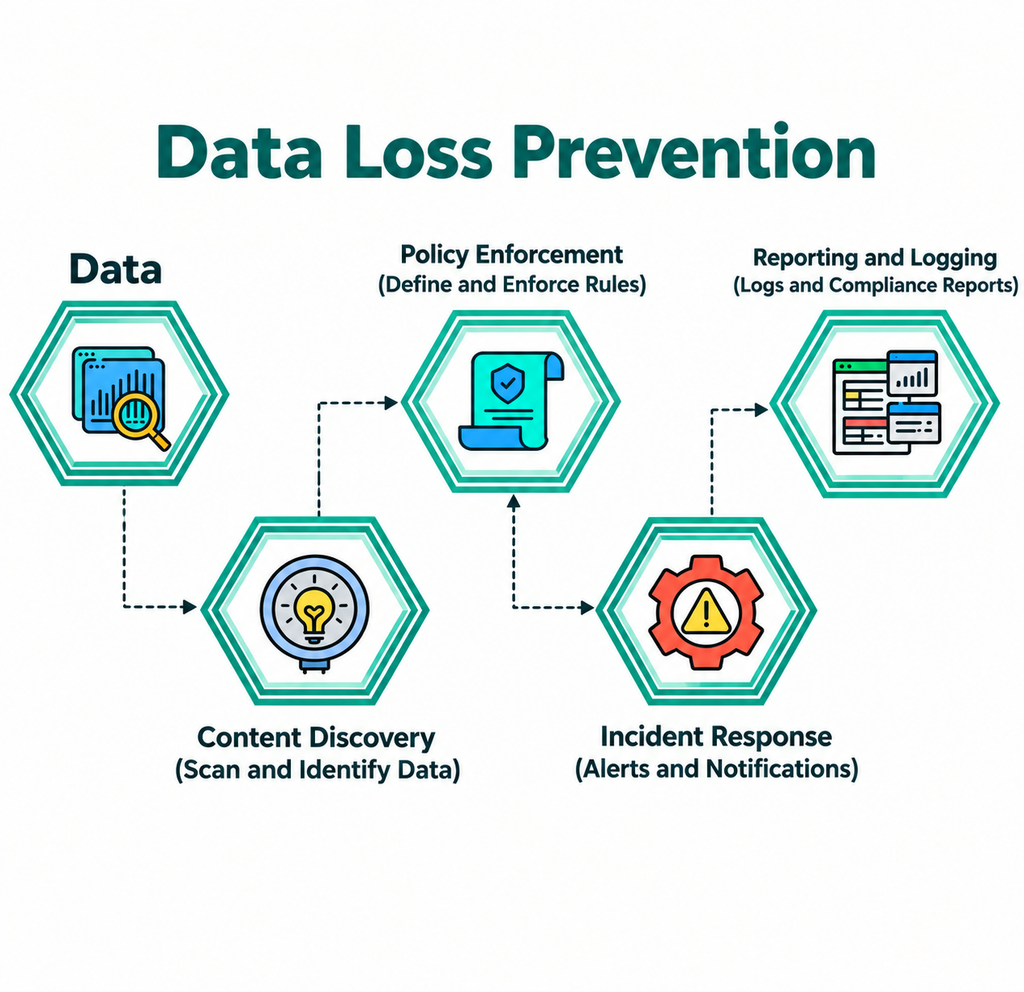
Data Loss Prevention is a combination of security policies, technologies, and processes designed to protect sensitive data from unauthorized access, sharing, or exposure.
A DLP strategy can monitor how information is created, accessed, transferred, and stored. Depending on the organization and the tools being used, it can identify sensitive information and apply specific rules when someone attempts to move or share that information in an unsafe way.
For example, a company may create a policy that prevents confidential customer information from being sent to an unauthorized external email address. This type of control can help organizations maintain better visibility over their sensitive information.
Why Is Data Loss Prevention Important?
Organizations face many potential risks when managing sensitive information. Human mistakes, weak security controls, compromised accounts, unauthorized access, and poorly managed devices can all contribute to data exposure.
A strong Data Loss Prevention strategy can help businesses:
- Protect confidential information
- Reduce accidental data exposure
- Monitor sensitive information
- Improve security policies
- Support compliance requirements
- Control how information is shared
- Identify unusual data-handling activities
DLP is not a complete solution for every cybersecurity threat. Instead, it should be used as one part of a broader security strategy.
How Does Data Loss Prevention Work?
DLP generally begins by identifying the information that needs protection. Organizations can classify data according to its sensitivity, importance, and business value.
After sensitive information has been identified, security teams can create policies that determine how that information should be handled.
For example, a business may classify financial records as confidential. A DLP system can then monitor activities involving those records and apply predefined rules when certain actions occur.
Where Can DLP Be Used?
DLP controls can be applied across different environments, including:
- Cloud storage
- Company networks
- Computers and laptops
- Mobile devices
- Business applications
- File-sharing platforms
The exact features available depend on the DLP solution and the organization’s security configuration.
The 10 Data Loss Prevention Best Practices
1. Identify Sensitive Data
The first step in creating an effective DLP strategy is understanding what information needs protection. Businesses should identify confidential documents, customer information, financial records, intellectual property, employee information, and other important data.
Without knowing where sensitive information exists, it becomes difficult to create effective protection policies.
2. Classify Information Properly
Data classification can help organizations separate information into categories such as public, internal, confidential, and highly sensitive.
Clear classifications make it easier to apply appropriate security controls to different types of information. They can also help employees understand which information requires additional protection.
3. Create Clear DLP Policies
Organizations should establish clear rules for how sensitive information can be accessed, stored, transferred, and shared.
A good DLP policy should explain what information needs protection, who can access it, where it can be transferred, and what action should occur when a policy violation is detected.
Clear policies can also help security teams respond consistently to potential data-handling problems.
4. Control Access to Sensitive Information
Access to sensitive information should be provided according to legitimate business requirements. Employees generally should not have access to information that they do not need for their responsibilities.
Organizations can use role-based access controls and regularly review permissions to reduce unnecessary access.
Limiting access can help reduce the number of people who can view, modify, or share sensitive information.
5. Monitor Data Movement
Sensitive information can move between email accounts, cloud services, external storage devices, business applications, and other platforms.
Monitoring these activities can provide better visibility into how important information is being handled. Security teams can use this information to identify unusual activities that may require investigation.
Effective monitoring can also help organizations understand where sensitive information is being transferred and whether existing policies are working as intended.
6. Educate Employees
Technology alone cannot prevent every data security problem. Employees also need to understand how sensitive information should be handled.
Regular security awareness training can educate employees about safe file sharing, suspicious messages, unauthorized applications, password security, and common data-handling mistakes.
When employees understand the importance of data protection, they can become an important part of the organization’s overall security strategy.
7. Protect Cloud-Based Information
Many businesses now depend on cloud applications and storage services. This creates additional locations where sensitive information can be stored, accessed, and shared.
Organizations should regularly review cloud permissions, account security, sharing settings, and access policies as part of their overall DLP strategy.
Businesses should also understand which cloud services are being used and what type of information is stored in each environment.
8. Review Security Policies Regularly
Technology, business operations, and security threats change over time. A DLP policy that was effective several years ago may not fully address current requirements.
Businesses should periodically review their policies and update them when new applications, devices, data types, or business processes are introduced.
Regular policy reviews can help organizations maintain controls that match their current technology environment.
9. Use Encryption Where Appropriate
Encryption can help protect information by making data unreadable to unauthorized parties without the appropriate key or access mechanism.
Organizations should consider encryption as one layer within a broader data protection strategy, particularly for sensitive information that is stored or transmitted through potentially exposed environments.
Encryption does not replace other security controls, but it can provide an additional layer of protection for important information.
10. Test and Improve the DLP Strategy
A DLP program should not simply be configured and forgotten. Organizations should test their policies, review alerts, investigate unusual activities, and adjust controls when necessary.
Regular testing can help identify gaps in the security strategy. It can also reduce unnecessary alerts and help security teams focus on activities that require attention.
Continuous improvement is important because an organization’s technology, employees, applications, and security requirements can change over time.
Common Data Loss Prevention Challenges
Although DLP can provide valuable security benefits, implementing it can also create challenges.
Poorly configured policies may generate excessive alerts, while overly strict rules can interfere with legitimate business activities. Security teams therefore need to balance protection with normal business requirements.
Another challenge is understanding where sensitive information is stored and how employees use it. Modern organizations may rely on numerous applications and cloud services, making data visibility more complicated.
For this reason, organizations should introduce DLP policies carefully and improve them based on actual business requirements and security observations.
Data Loss Prevention and Cybersecurity
Data Loss Prevention is only one component of a broader cybersecurity strategy. Organizations should also consider identity management, access controls, endpoint security, network protection, secure backups, employee awareness, and incident response.
Combining these security measures can create a more comprehensive approach to protecting critical information.
For example, strong authentication can help protect user accounts, while DLP policies can focus on how sensitive information is accessed and shared. These controls address different parts of the overall security process.
Benefits of a Strong DLP Strategy
A properly planned DLP strategy can provide several benefits to an organization. It can improve visibility into sensitive information, support internal security policies, and help reduce certain types of accidental data exposure.
It can also help security teams understand how important information moves throughout an organization. This visibility can make it easier to identify security gaps and improve data-handling practices.
Some potential benefits include:
- Better visibility into sensitive information
- Improved control over data sharing
- Reduced accidental exposure
- Stronger internal security policies
- Better understanding of data movement
- Improved data-handling practices
However, the effectiveness of a DLP program depends on proper planning, configuration, employee awareness, testing, and ongoing management.
Final Thoughts
Data Loss Prevention has become an important consideration for organizations that collect, store, and share sensitive information. As businesses increasingly depend on cloud services, remote work, digital communication, and online applications, protecting important data requires more than basic security measures.
Organizations can strengthen their approach by identifying sensitive information, classifying data, controlling access, monitoring data movement, educating employees, using appropriate security technologies, and regularly reviewing their policies.
A successful DLP strategy is not simply about blocking data transfers. It is about understanding where sensitive information exists, how it is used, and how it can be protected while allowing legitimate business activities to continue.
Read More : Hb Seo Service