Leasing CodeHS Answers: Finish, explanation, and understanding tips.
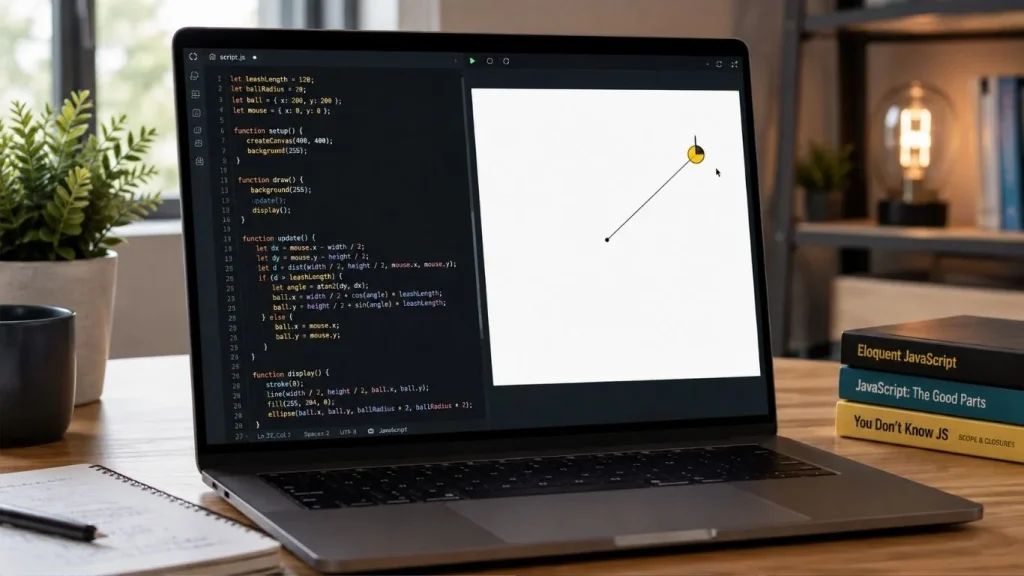
leash codehs answers
Introduction
If you’re taking your programming class on CodeHS, you’ve more than likely seen Leash. Typically included in Karel the Dog class where students acquire basic commands and logic. There are students who look for online “leash codehs answers” to help them with their assignment. Copying answers to problems is not the way to learn programming — you need to understand the concept and solve the problem yourself.
In this article, we will explain why the exercise is asking you to do Leash, what is behind it, and how to do it.
What is Leash Exercise?
The leash codehs answers exercise on CodeHS is included in Karel programming. Karel is a tiny robot (or dog) that will do what you tell it. The primary purpose of this activity is to get students to understand:
How the order (sequence) of commands works
Use of functions and loops
Dividing a problem into smaller parts (decomposition)
The “Leash” theme is similar to walking a dog — you move Karel step-by-step and in a controlled fashion just as you would do with a dog on a leash.
This is Basic Logic of Leash CodeHS.This is Basic Logic of Leash CodeHS from the beginning.
The following are the basic commands of Karel which are most frequently utilized in most Karel exercises:
The move() procedure causes Karel to move one step forward.The procedure move moves Karel one step forward.
Turns Karel to his left.Turns to his left.
Description: Places a ball.putBall() — puts a ball.
pick up a ball.takeBall() — picks up a ball.
The default behaviour of Karel is only to turn left, if you want him to turn right, you have to write turnLeft for three times.
In the Leash exercise you usually control Karel to take him around in a certain trajectory: forward, turn, and back. In this case, make sure your logic is clear, step-by-step.
Step by Step Approach – Learning is Not Just Getting the Answer
In this instance we are NOT giving you the exact answer to copy and paste, we are providing you with the correct way of thinking (approach) that will be applicable to any Leash-style exercise.
In Step 1, read the problem.In Step 1, read the problem.
First take careful note of the grid on the screen and the starting position of Karel. Take note of the instructions for Karel to move to and what Karel is supposed to do.
Step 2: Make the Plan for the Path
In your mind or on paper, work out how many steps Karel will take, in which direction Karel will turn and where Karel will stop.
In this step, small functions will be created.
In Step 3, small functions will be created.
If a movement occurs frequently (e.g. right turn) write a function for it:
Javascript
function turnRight() {
turnLeft();
turnLeft();
turnLeft();
}
Step 4: Enter Main Code
Now write them down in sequence as per your plan:
Javascript
function start() {
move();
move();
turnRight();
move();
}
Step 5: Run and Test
Run the code. If Karel is not at the correct location, review the steps again, as that is the true debugging skill!
Some of the most common errors that students encounter.
Misusing turns — Taking a right turn that requires three left turns.
Wrong number of move() statements — Either too many or too few.
Failing to use functions — If code is not written in a function, the code is lengthy and difficult to understand.
Copying the answer – This can present difficulty in quizzes or exams as the concept is not understood.
The drawbacks of simply copying the answers.
Others believe that copying “leash codehs answers” will complete in a shorter time frame. However, the disadvantages are:
You never really learn the programming concept until you are coding it.You don’t know the programming concept until you’ve coded it.
Have trouble with future exercises, tests.
Your problem-solving skills don’t get developed
This knowledge will not be of any help in interviews or actual projects.
The aim of CodeHS is not to assign grades; it’s to teach you coding.
A Better Way: Tips for Solving It Yourself!
Know the meaning of each command and apply it
Divide the problem into subproblems
If you see an error, don’t worry — it’s the way to learn how to fix it.
Use the hints and “Docs” section on CodeHS
Practice more – the more you write the better you will get
Conclusion
leash codehs answers” is a great way to get started with Karel programming concepts, such as sequence, functions and logic building. Searching the Internet for “leash codehs answers” and copying them is easy, but actually, when you learn what it’s about and work through the problem on your own, you’ll find that you have a great deal of success.
The art of programming is a learnable art. Don’t take shortcuts, take time, make mistakes, and learn from them. However, this is what will make you a good programmer.
Read More: HB SEO Agency